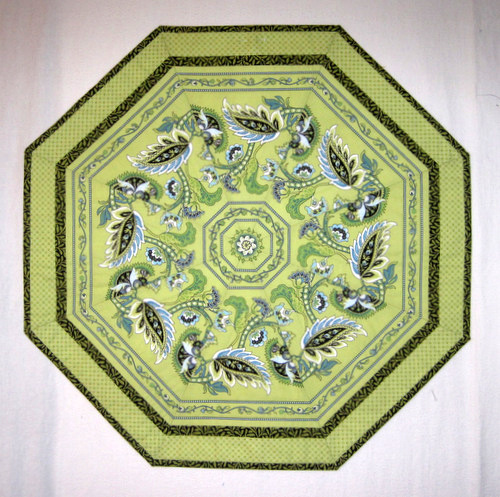
I drew my sister Diane’s name in the siblings and spouses Christmas gift exchange. And — she drew mine! That doesn’t happen very often. This is what I am giving her:
It’s a table topper. You may remember seeing the unfinished top in an earlier post. Diane saw that post and fell in love with the fabric (from the Ainsley line for Northcott Fabrics) and the kaleidoscope block. When I drew her name, I decided to finish the table topper for her.
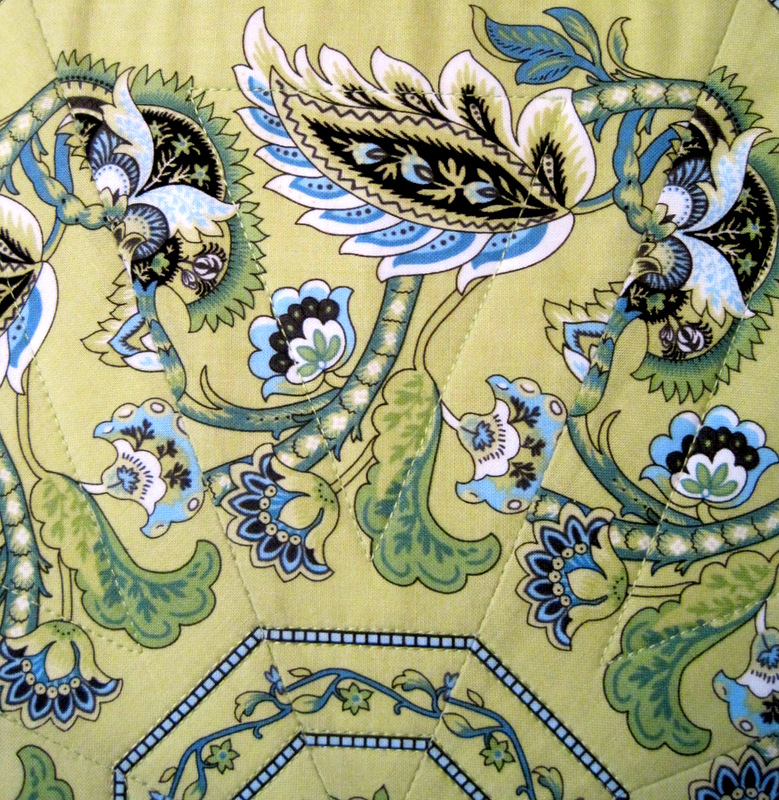
I didn’t want the topper to be poufy so I used flannel for the batting. It’s quilted very simply. First I stitched in all the ditches and then quilted on both sides of the straight lines in the center and outer edges. Then I quilted a triangle in each of the eight wedges of the kaleidoscope. The simplicity of the quilting keeps your eye focused on the flowers and leaves and vines in that gorgeous Jacobean print:
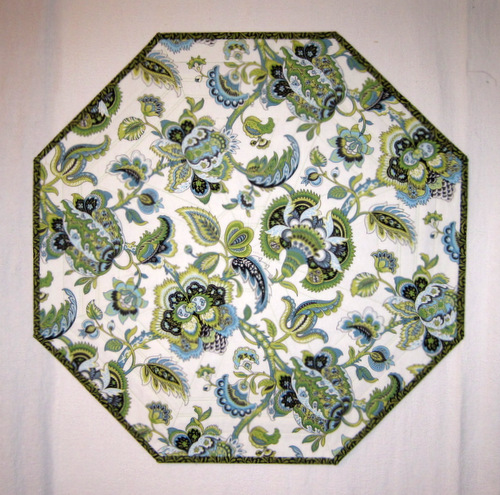
Here’s the back of the topper:
I had never before applied binding to a quilt with obtuse angles (greater than 90 degrees but less than 180). Thanks to Heather Mulder Peterson of Anka’s Treasures, who posted a terrific tutorial on her blog, Trends and Traditions, it was a breeze.
Diane’s table topper — #5 in my series of kaleidoscope quilts — measures 22″ across and 22″ top to bottom.
I hope she likes it — and I hope she doesn’t see this post until after she opens her gift!
Do you have any idea how hard it is to find men’s shirts with two simple patch pockets? It’s the only kind the Dear Husband likes to wear. Most shirts nowadays are made with one pocket — or none at all. On the rare occasions when I spot dress or casual shirts with two pockets, I buy several. It’s been a few years since I’ve found some, and many of the DH’s shirts are wearing out. (If you see any two-pocket shirts during your holiday shopping expeditions, please email me!)
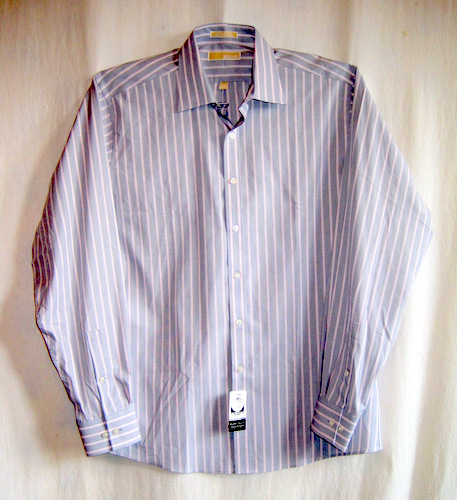
Macy’s was having a big sale on men’s shirts last week so I picked up a few. Alas, none of them came with two pockets. I’ll show you what I did to remedy that (something I’ve been doing for 30-odd years).
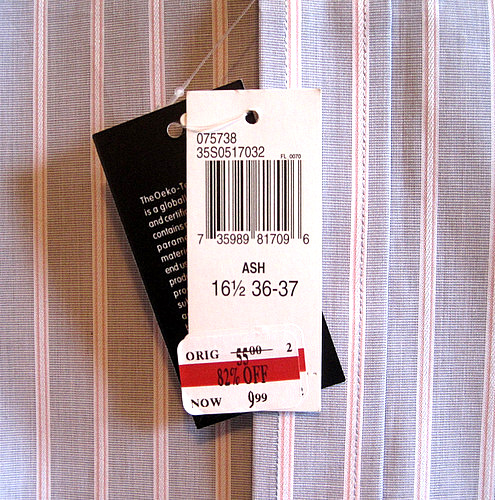
This particular shirt had no pockets:
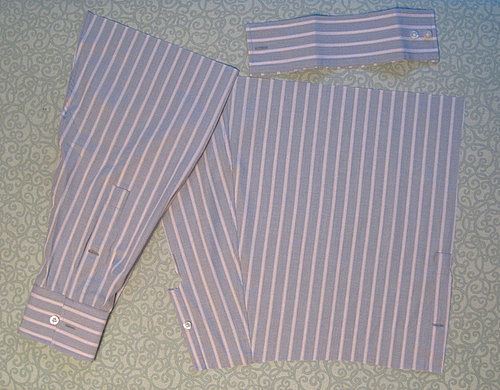
First, I cut off the sleeves at elbow length and narrow hemmed them. I cut the lower part of one sleeve apart and pressed it flat:
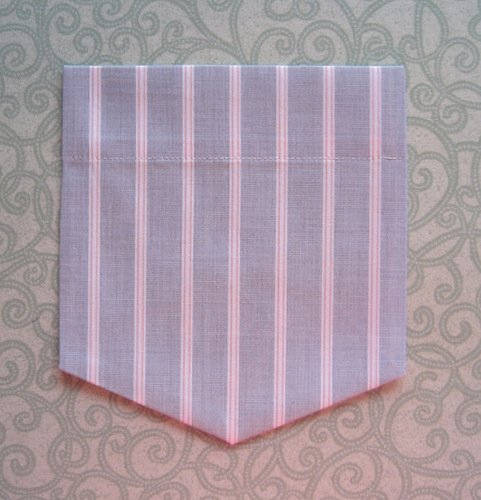
These sleeves were extra long so I was able to fashion two pockets out of one sleeve remnant. Here’s one of the pockets as seen from the front . . .
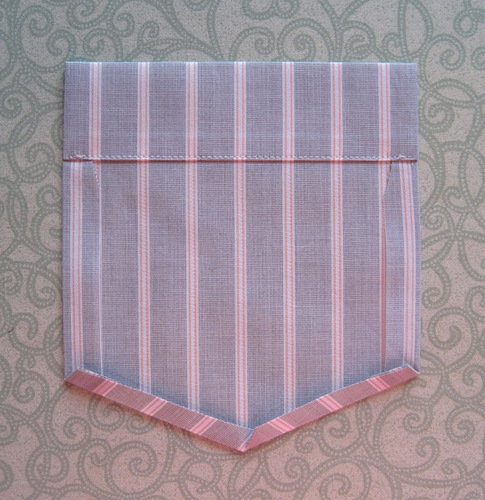
. . . and from the back:
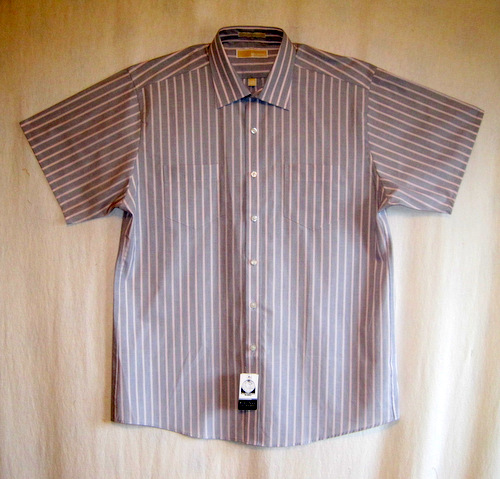
Here are both pockets made and sewn onto the shirt:
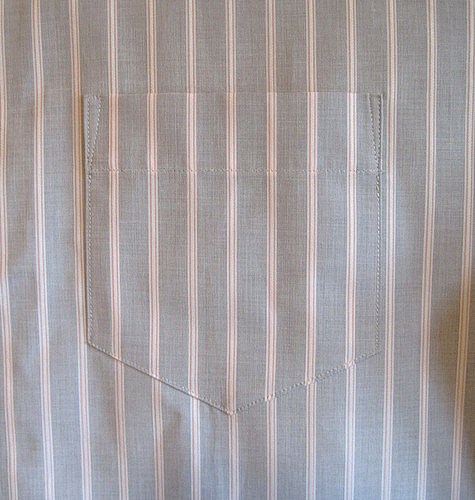
It’s a little hard to see these pockets because the stripes are matched. Here’s a close-up:
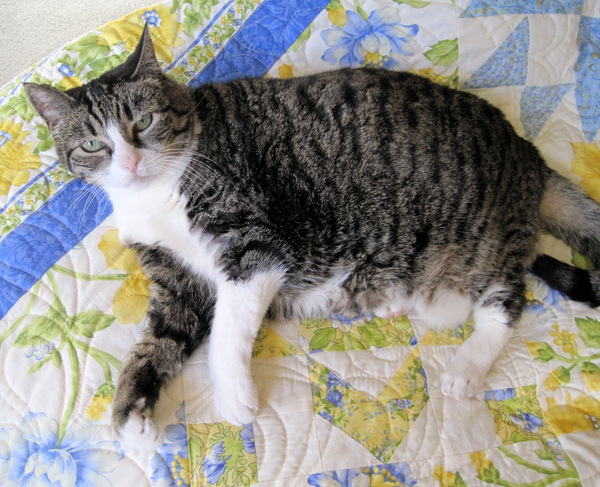
I had no idea, when I took this photo in September, that we would be saying goodbye to Elfie so soon. She was 18, and we had her for 16 years, the longest we’ve had any cat. We had her put to sleep last night after a very short illness. At least she didn’t suffer long.
We got Elfie at the Oregon Humane Society when she was about two. She came with the name Monkey, which we promptly changed. All our cats are named after royalty — this is what happens when your husband is a retired history professor — so she was renamed Queen Elfgifu, Elfie for short. (In case you’re not up on your 10th century English history, Queen Elfgifu was married to King Eadwig — and yes, we once had a cat named Eadwig.)
Elfie wasn’t allowed on my quilts because she was a kneader. I was refolding quilts one day in September and when I turned around, there she was stretched out on the quilt pictured above, looking very content. I grabbed my camera and took a couple of photos before ushering her off the quilt.
She was the sweetest cat ever. The Portland White House won’t be the same without her.
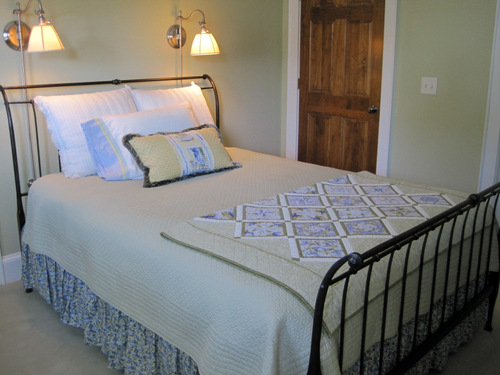
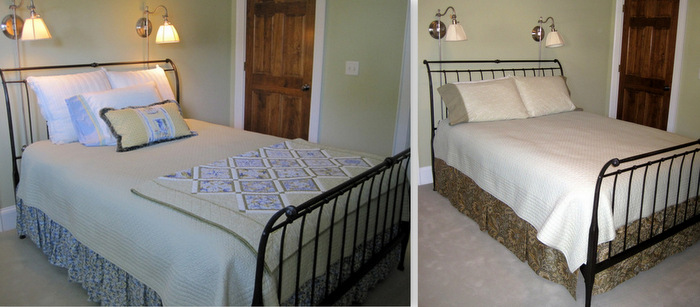
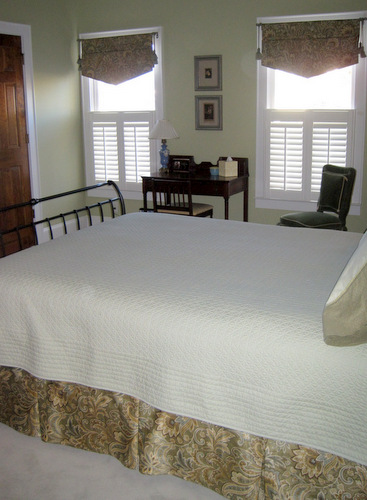
When I visit my twin sister Diane in Atlanta, there’s usually a home decorating project in the works. During my current two-week Thanksgiving stay (nearing its end, alas), I made a new bedskirt and window treatment for her downstairs guest room.
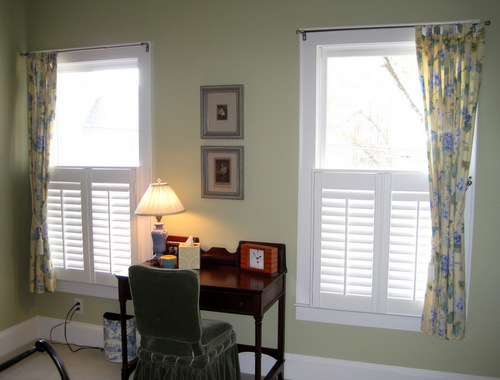
When Diane and her husband Ed moved into their present home 10 years ago, I made simple tab curtains for the windows:
The ruffled bedskirt, which I had made several years before, was a carryover from their old house:
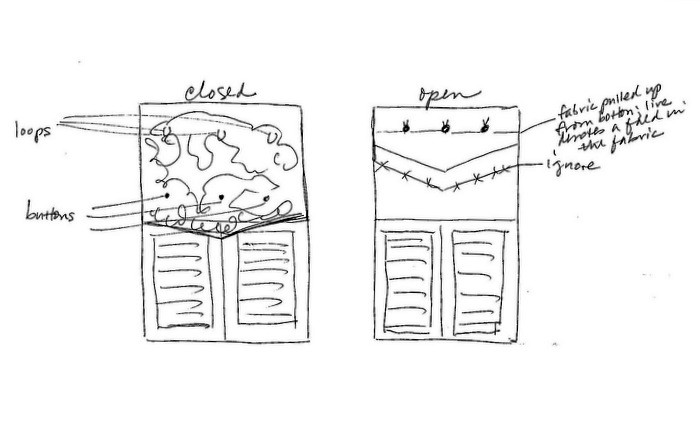
This time around Diane wanted a tailored bedskirt and some kind of window treatment that could be raised and lowered. She wasn’t happy with the idea of Roman shades or any variations on that theme, so she came up with her own design: a simple pointed panel in the “down” position that folds and buttons into a valance in the “up” position.
She made a sketch of what she had in mind:
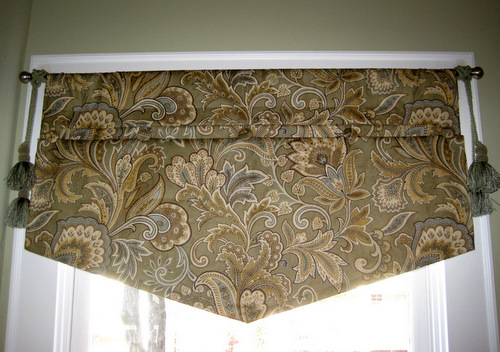
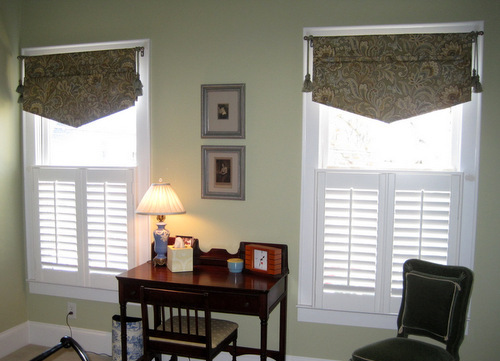
Here is Diane’s vision, transformed into reality:
She had the bright idea of adding tassels on the sides of the panels to disguise the brackets holding the curtain rods. Clever sister!
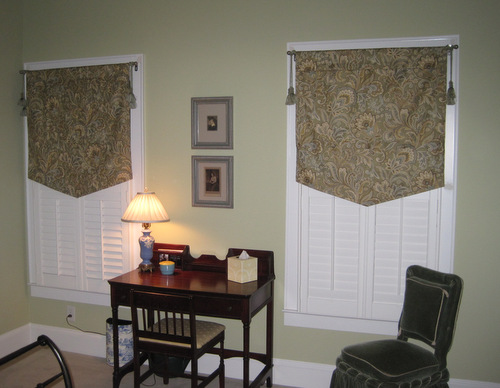
In the “down” position, the panels just cover the tops of the plantation shutters on the bottom half of the windows, completely blocking outside light:
In the “up” position, natural light floods the room:
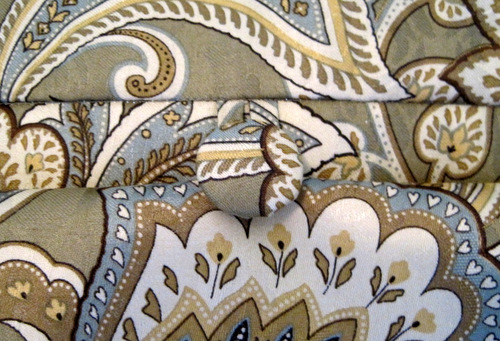
The panels measure 34½” wide and 36½” long and are lined with blackout fabric. Five inches from the top of each panel are five self-fabric loops enclosed in a seam. About 21” down from the top are five ¾” buttons covered in the same fabric. The loops and buttons blend into the background so well you barely see them. A deep pleat is formed when the buttons are raised to meet the loops.
Here is a close-up of button and loop:
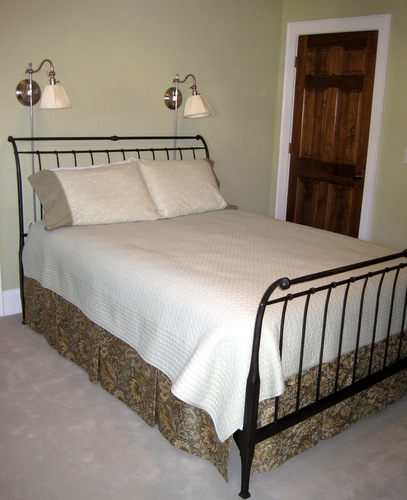
The fabric is a screen print by Mill Creek Fabrics that Diane found at Frugal Fabrics in Norcross, Georgia. The new pleated bedskirt is made from the same fabric:
The reward for my labors? I’m going home with the castoffs! I’ll probably be able to use the old tab curtains in my own home, and I’ll cut the bedskirt apart and add the ruffle fabric to my stash.
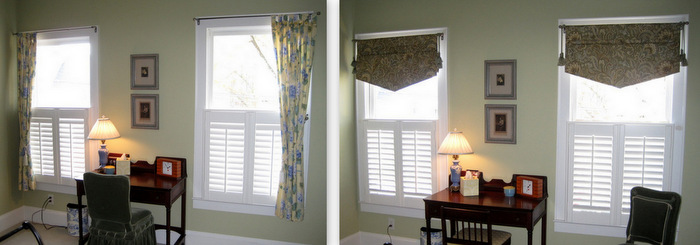
Here are a couple before-and-after shots. First the windows:
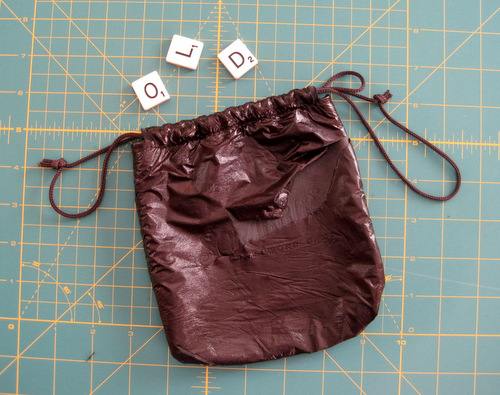
Scrabble is on the daily agenda at my sister Diane’s house in Atlanta where my husband and I are visiting. During our two-week visit over Thanksgiving this year, we will probably play at least 20 games. The three of us are pretty evenly matched in skill and extremely competitive — unless one of us has the possibility of a seven-letter word, in which case the other two jump in to help.
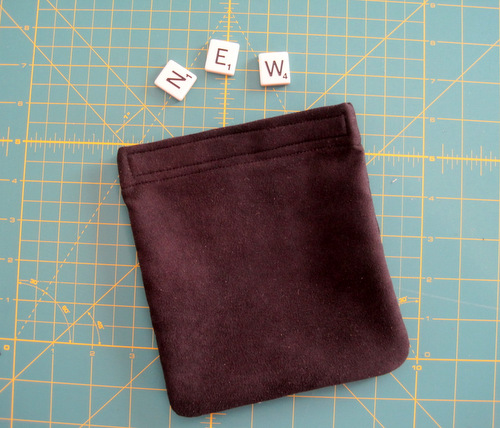
The bag that holds Diane’s Scrabble tiles was in pretty sad shape so I decided to make her a new one. I found some soft sueded fabric at JoAnn’s the other day when Diane and I were picking up notions for the home dec projects I’m working on while here (subject of a future post).
It took a mere half hour to make the Scrabble bag. Instead of making a casing at the top for a drawstring, I sewed Velcro strips.
If my Dear Husband were reading this post, he would look perplexed and say, “An apron for the Designated Hitter?” No, dear. Not even close.
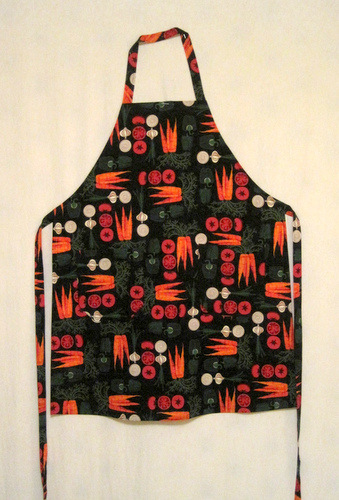
I made him an apron today because his old one was pretty worn out. Here’s what his new apron looks like:
Carrots and Onions and Peppers, Oh My!
It’s a basic cobbler’s apron made from a Simplicity pattern dating back to the 1980s. I’ve probably made him a dozen aprons over the last 30 years using that same pattern. He wears one in the morning when he makes breakfast and in the evening when he cleans up the kitchen after I’ve made dinner. (You can see why I’m happy to keep making aprons for him.)
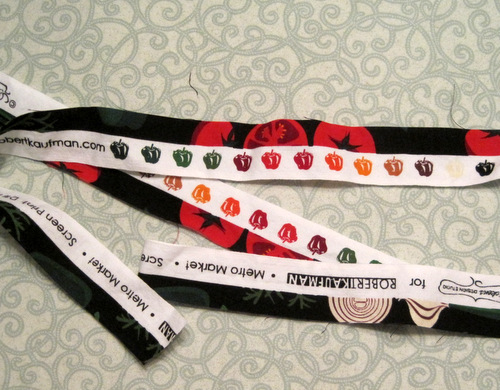
My DH is the gardener of the family so the veggie fabric, Metro Market by Pickens Design Studio for Robert Kaufman, was the perfect choice for him. I found it at cool cottons in SE Portland. It was the selvage that sold me. Look how the colors are printed on the selvage:
A Peck of Pickled Peppers?
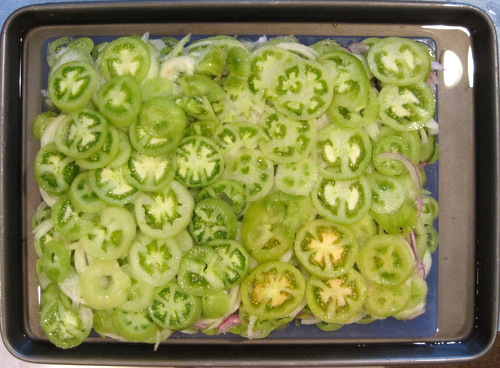
Speaking of veggies, we had a bountiful crop of tomatoes this year, including some that continued to ripen during our unusually warm and dry October. My husband harvested all of the remaining green ones and decided to preserve them. He started with five alternating layers of sliced green tomatoes and onions . . .
Tomatoes and Onions, Sliced
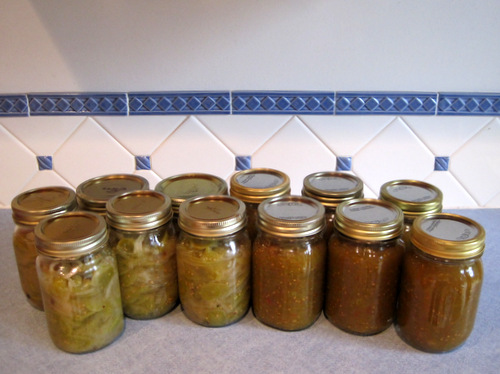
. . . and ended with six pints of green tomato pickles and six of green tomato relish:
After returning last month from a week in Sisters, Oregon, home of the largest outdoor quilt show in the world, I posted about the quilt show and the terrific class I took. Before I had a chance to write a third post about what I accomplished that week, my husband and I left on a road trip to California to visit our two youngest granddaughters (9 and 12). We brought them back to Portland to spend a few days with us. My sewing and quilting projects languished but I didn’t mind because I was having such fun with the girls.
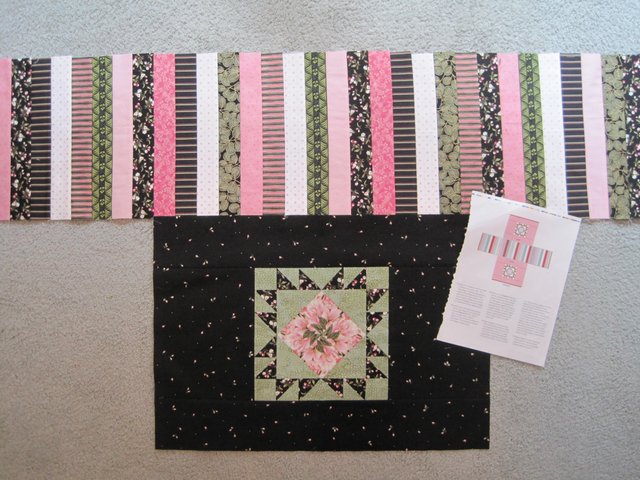
They are home in San Francisco now. The house is quiet. Elfie the cat has come out of hiding. And I’m back in my sewing room taking stock of the projects I worked on in Sisters. Remember the sewing machine cover designed by Monique Dillard of Open Gate Quilts that I posted about here? This is my version so far:
sewing machine cover, in progress
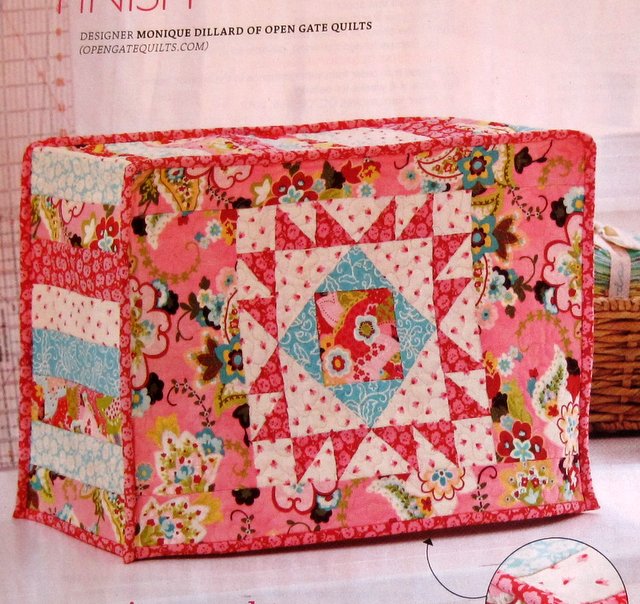
When it’s finished, it will look something like this:
Monique Dillard’s design
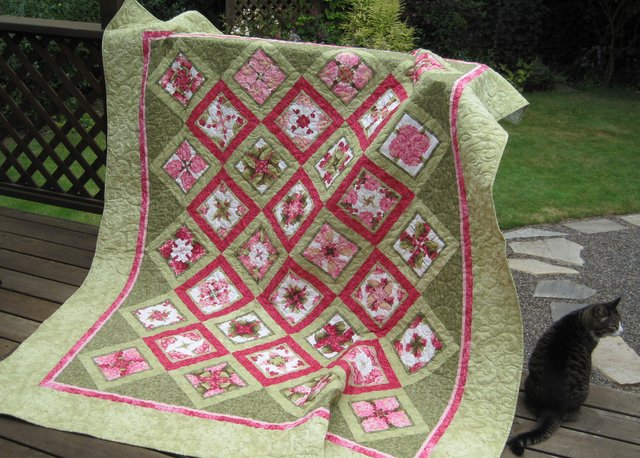
I finished binding my pink and green quilt, Framboise, made from my 4-Patch Wonder pattern:
Framboise, bound but not labeled
When the label is on, I’ll declare the quilt finished and post a proper picture in my Gallery. That’s Elfie, by the way, who doesn’t seem the least bit interested in my quilt.
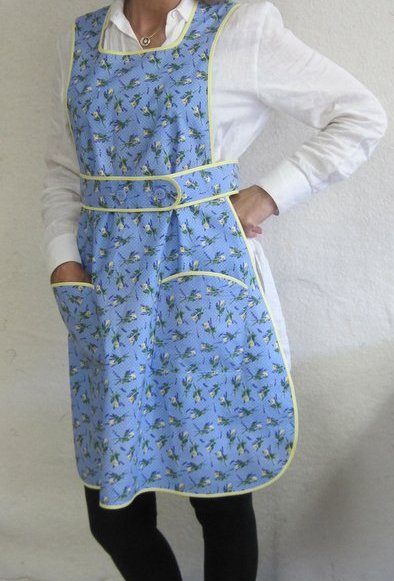
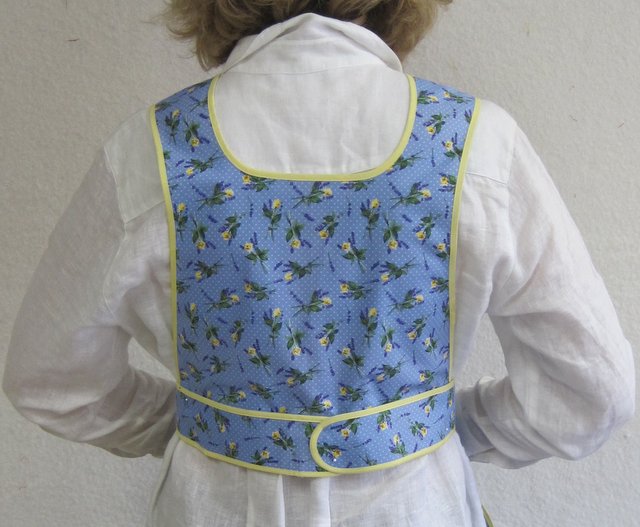
I’m very excited about my newest design, the Monterey Bay Apron. After making eight versions and tweaking each one, I’m finally satisfied with the cut and the fit. Here is a look at Number Nine:
Monterey Bay Apron
back of Monterey Bay Apron
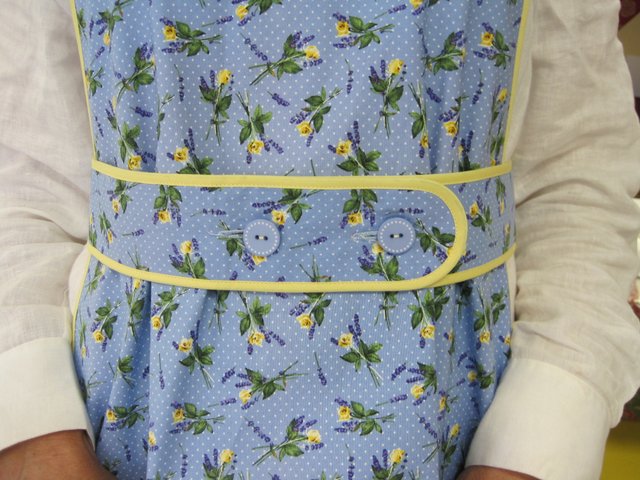
The belt is secured to the back with buttons. In the photo above, the ends of the belt were temporarily pinned to the back, adjusted for my model, Geri. The ends can be positioned anywhere along the back, making the apron one-size-fits-most. Here is a close-up of the front:
detail, Monterey Bay Apron
The pattern should be available in just a few weeks!
I’ve spent the last week and a half with my two youngest granddaughters, nine and twelve, first in San Francisco where they live with their mom, then in Ashland, Oregon for three days, and now in Portland, where they will stay with their grandpa and me until Friday.
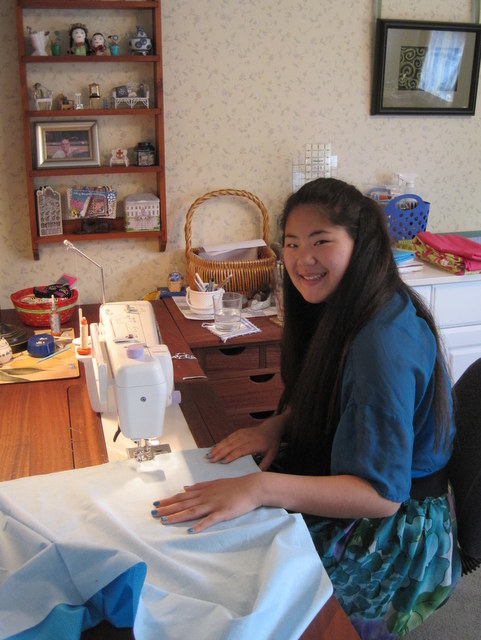
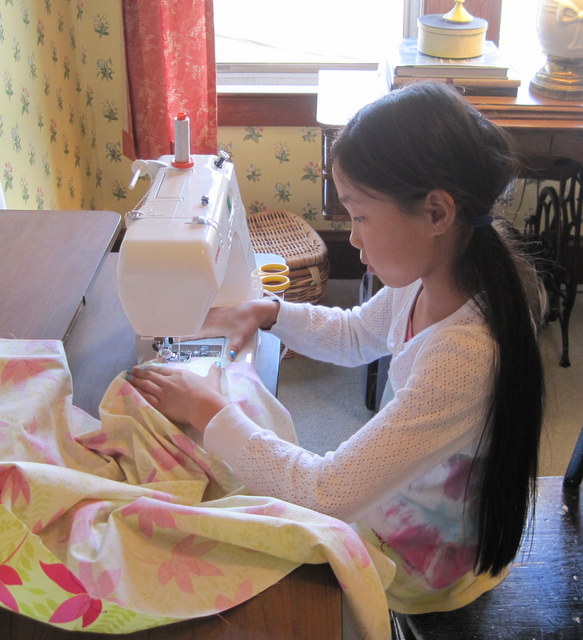
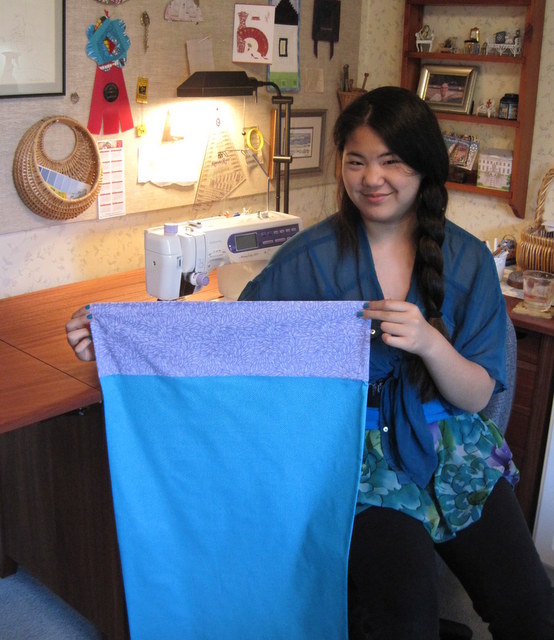
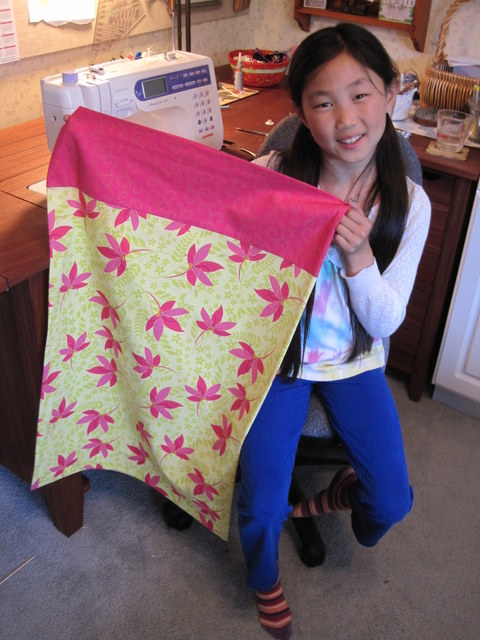
We have a lot planned for our five days in Portland! One of the things on my wish list was to help the girls make their own pillowcases. They were all for it, which made their granny very happy. Today was the day. Each girl picked her own fabric from my (ahem) considerable stash. Twelve-year-old Bonnie selected a vibrant turquoise mini-dot for the body of her pillowcase and a lilac floral for the band. Beatrice, age nine, chose a lime green fabric with fuchsia blossoms for the body and a fuchsia vined print for the band.
Bonnie worked in my sewing room:
Bonnie, with pillowcase in progress
Beatrice sewed on the smaller machine that I set up in the spare room across the hall:
Beatrice, with pillowcase in progress
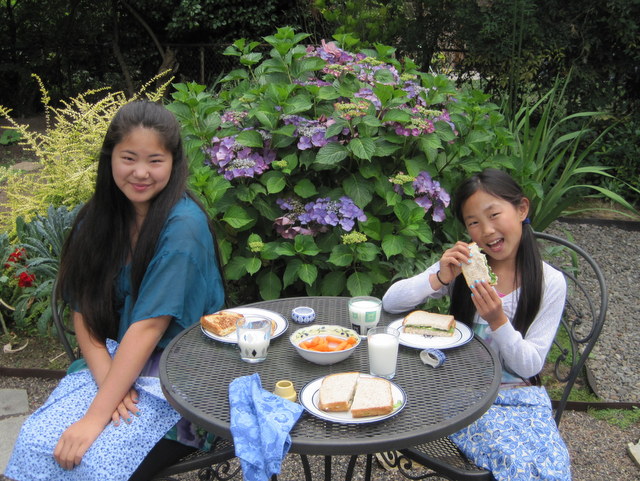
After a break for lunch in the garden . . .
lunch al fresco
. . . we headed back to the sewing room. I taught the girls the roll-it-up method for pillowcases, which encloses both ends of the band in a single seam. The girls finished their cases with French seams, so there are no raw edges showing anywhere.
They did a beautiful job! Here is Bonnie with her finished pillowcase:
My sisters claim that I inherited the sewing gene and they didn’t. Maybe this is why I find myself engaged in home sewing projects whenever I visit them. They joke about shackling me to the sewing machine when they know I’m coming. If you take a look at the Home Dec section of my Gallery, you will see that the usual beneficiaries are the Usual Suspects (my sisters).
Our mother was an excellent seamstress, fast and accurate. She sewed all our school clothes and even made pajamas for us when we were little kids. This was back in the days when it was much cheaper to sew garments than to buy them. Every fall before school started, we would go shopping for fabric (we called it material back then) and patterns. Mother had veto power, though she rarely used it. We always had several new outfits to begin the school year, and we would pick our favorite to wear the first day. Mother worked full-time so how she found time to make all of our clothes and hers as well is a mystery to me.
My mother taught me to sew the summer before I started high school. I learned on an old White treadle sewing machine. I don’t remember where we got that sewing machine or what happened to it, but I sure wish I still had it. It sewed like a dream, once you got the rhythm of working the treadle. On my first day of high school, I proudly wore a dress I had made – a sleeveless shift with bias piping around the neck and armholes. It was a green and blue print, and I wore it with a blue velvet beret, which I thought was terribly chic but probably looked silly.
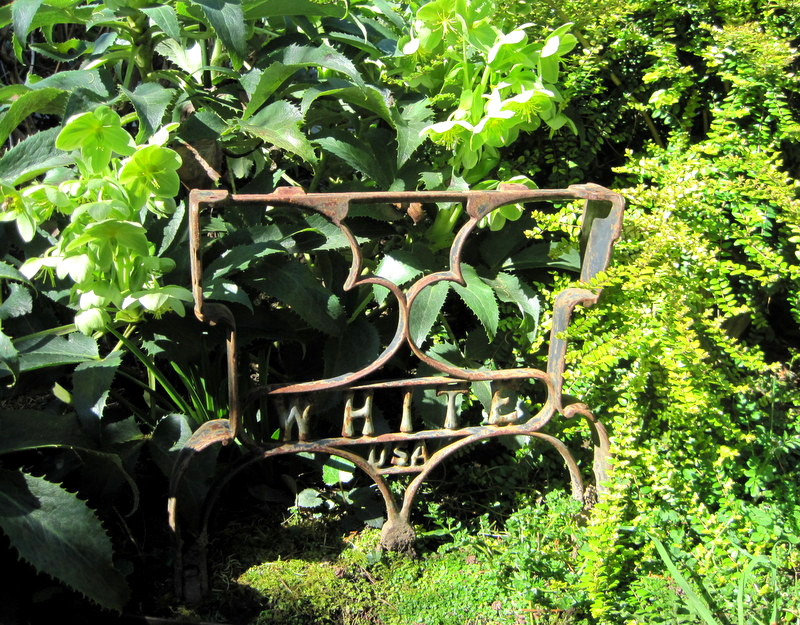
Last year, while antiquing at the beach with my quilt group, the Quisters, I found a wrought iron side support from an old White treadle sewing machine. It came home with me and now lives in the garden in the back yard. It’s a lovely reminder of my mother and the year my sewing gene kicked in.
I am lucky to own quilts made by two of my great-grandmothers.
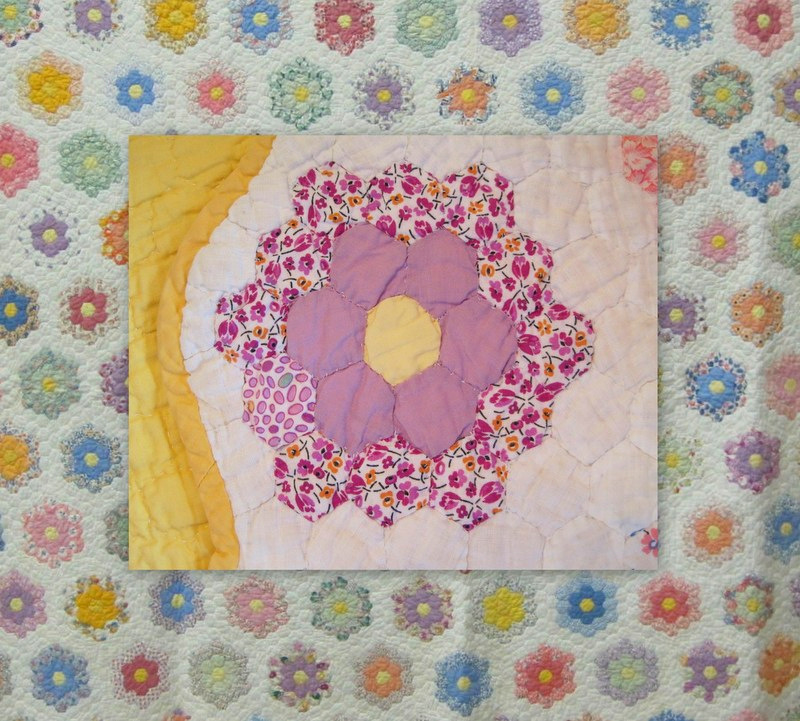
I treasure the Grandmother’s Flower Garden quilt made sometime in the 1930s by my maternal great-grandmother, Grace Violet (nee Watson) White (1873-1964). She was quite imaginative in the way she combined fabrics and replaced fabric she had run out of with something similar. She even fussy-cut some of the hexagons (decades before fussy-cutting came to be called that).
Grace’s Quilt, with Detail
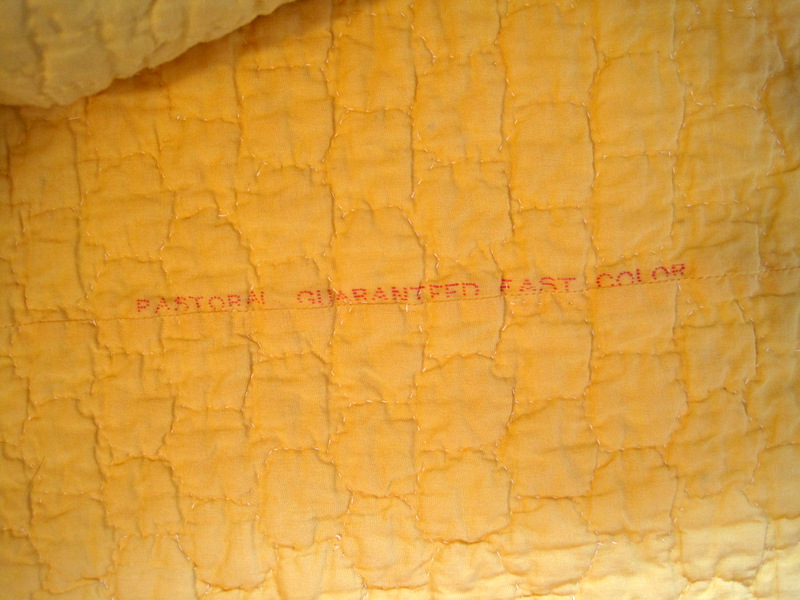
Apparently she didn’t waste a scrap of fabric. Printing from the selvage is visible along seams on the back: PASTORAL GUARANTEED FAST COLOR.
Detail, Back of Grace’s Quilt
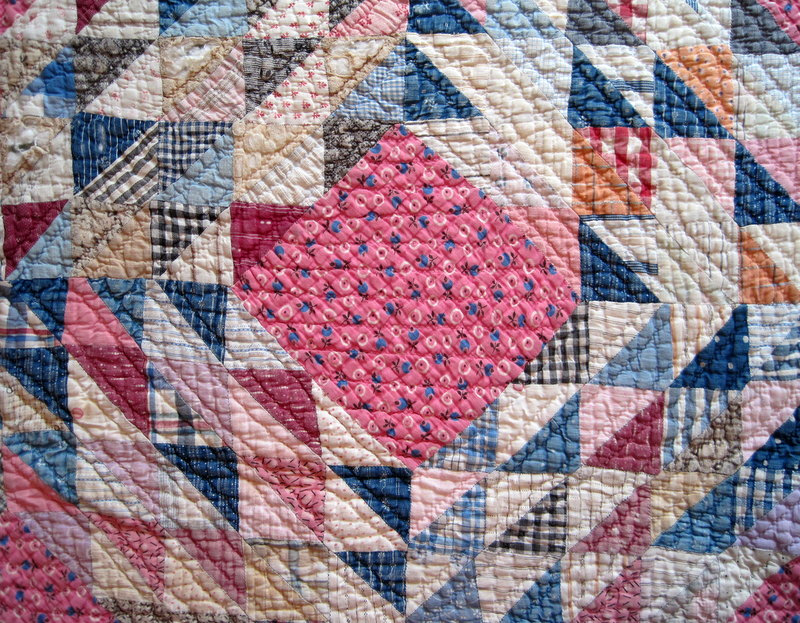
Equally precious to me is the Ocean Waves quilt made sometime in the late 1920s by my paternal great-grandmother, Magdalena (nee Naegeli) Weissenfluh (1862-1929). It’s not in very good condition but it is greatly loved.
Detail of Lena’s Ocean Waves Quilt
My father, who at 88 is sharp as a tack, gave me the back story on this quilt and the frame it was quilted on, which hung from the ceiling of Grandmother Lena’s home in eastern Oregon:
“Grandmother died in February 1929, some six months before my sixth birthday. My memories of her life are very fragmentary. I do remember, though, that when they [Grandmother Lena and her fellow quilters] were sewing the quilt top together they had me iron the scraps, which came out of the ragbags all wrinkled. Some of those patterns appealed to me and some didn’t. I could still point to some of those on the quilt. The quilt top was sewn on a treadle sewing machine.
“Now to the quilting frame: It was four pieces of wood, perhaps one inch thick, two or three inches wide. Two of them were a foot and a half or two feet longer than the quilt was wide. The other two were shorter, maybe four feet long. Each piece of wood had a row of holes about two inches apart running the full length of the piece. Lay the two long pieces parallel to each other and perhaps three feet apart. Lay the two shorter pieces across the others, near the ends, making a rectangle of the whole thing. Think of using four good sized nails dropped through the holes (the holes being large enough that the nail would be a loose fit within it), anchoring the four pieces together.
“Then think of the quilt rolled up on one of the two longer pieces, with enough of the quilt pulled off to reach to the other longer piece. Sort of like film in a camera, being spooled off one spool onto another. Now think of four eye bolts anchored into the ceiling with a cord dangling down from each. Each cord has a loop on the bottom end big enough to slip over the end of the long pieces. Think of the cord being of a length that would put the quilting frame at something like bosom height of a woman seated in a kitchen chair.
“Two chairs on each side of the frame, four nattering ladies with needles and thread, pushing the needle first from top to bottom, then reaching under the quilt and pushing it back from bottom to top. The quilters were my grandmother, my mother, and my aunt Mandy, plus any other woman who happened to show up. As one panel was completed, the nails would be temporarily removed, and the completed portion of the quilt would be spooled onto the receiving spool and then the nails dropped back in place and the work continued until all the entire quilt has been spooled from one side of the frame to the other.”
Isn’t that a marvelous description?
Sometime in my quilting life, I plan to make a Grandmother’s Flower Garden quilt and an Ocean Waves quilt, in homage to my great-grandmothers Grace and Lena.